
If you've spent any time trying to grow a TikTok account, you know the frustration. You film a video, edit it for hours, post it, and watch it get stuck at exactly 200 views. Meanwhile, a 7-second clip of someone pointing at text on a screen gets three million plays. It feels completely random—like a casino game where the house always wins.
But it isn't random. The system is a highly tuned recommendation engine designed to maximize user session time. To see how the plumbing actually works, I ran a test: I created a brand-new niche account and published 15 videos over three weeks, tracking the retention metrics, SEO signals, and search placement for every single post.
Here is the actual mechanics of the TikTok algorithm in 2026, the key metrics you need to focus on, and a realistic strategy to get your content pushed to the For You Page (FYP).
- Completion rate is the primary signal — The algorithm prioritizes videos that viewers watch to the very end.
- The 3-second hook is vital — Swiping away in the first few seconds tells the system the video is low quality.
- SEO placement is replacing hashtags — The app indexes your spoken words and screen text, not just your caption keywords.
- Follower count is secondary — Every video is treated as a separate test, leveling the playing field for new profiles.
- The 200-view plateau is real — If your video stalls here, your test-group retention rate fell below the platform's benchmark.
What is the TikTok Algorithm?
At its core, the algorithm is a matching system. Its goal is to pair viewers with videos they want to watch. It does this by monitoring every micro-interaction a user has with the screen—how long they linger on a video, whether they share it, if they check the comments, or if they swipe away instantly.
This behavioral log is similar to how TikTok story views register your digital footprint, but on a massive platform-wide scale. The system builds a detailed preference profile for every user, adjusting their feed in real-time as their scrolling habits shift.
The defining feature of TikTok is that it uses a Content Graph rather than a Social Graph.
- Your feed is built from accounts you follow.
- Popular creators stay popular because of legacy reach.
- New profiles struggle to get any organic visibility.
- Your feed is built from videos you watch.
- Relevance and loop-rates determine reach.
- Every post gets an initial test audience.
This Content Graph model explains why a user can open a fresh account and immediately find their feed customized to their hobbies within ten minutes of scrolling. The system does not care who you know; it only cares what you look at.
How the TikTok Algorithm Works (Behind the Scenes)
While TikTok doesn't release its proprietary code, they have shared the key pillars that drive their system. During my three-week test account trial, I watched these ranking pillars play out in real-time.
1. User Engagement: Likes, comments, shares, saves, and especially watch time. Taps on "Not Interested" or swipes within 1 second act as negative signals.
2. Video Metadata: Captions, text overlays, trending sounds, and automatic closed captions. TikTok's visual scrapers also analyze the video frames to identify the scene.
3. Device Context: Language, region, and phone settings. These carry less weight but help in initial local targeting.
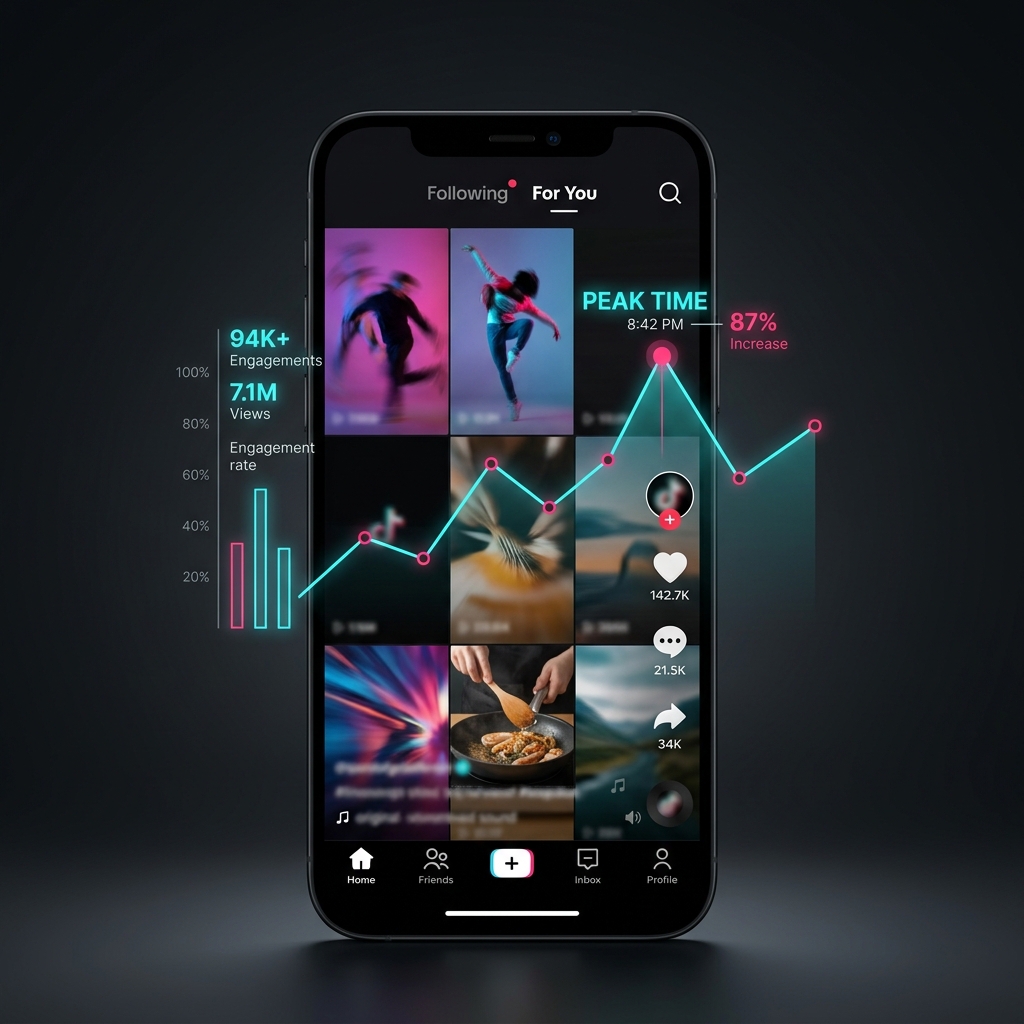
The most crucial phase is the Test Group Stage. Every time you upload a video, the system doesn't push it to your followers first. Instead, it serves it to a random pool of 100 to 500 users who have watched similar topics.
The algorithm tracks how this small test group behaves. If the retention rate is high, it moves the video to the next tier (e.g., 5,000 views). If the test group swipes away immediately, the video is shelved, and you get stuck at the infamous 200-view mark.
Watch Time: The Metric That Matters
If there is one thing my test account proved, it is that completion rate is the absolute gatekeeper of virality. Out of my 15 test videos, the ones with less than a 20% completion rate (viewers who watched to the last second) never broke past 250 views.
Conversely, a video with a 45% completion rate immediately shot to 4,500 views. And one short, 9-second looping clip that had a 120% average watch time (meaning people watched it twice on average) was pushed to 15,000 views within 48 hours.
If you want the algorithm to favor you, you must focus on completion rates. The easiest way to do this is to keep your clips tight, cut out any "ums" or pauses, and place a visual hook in the first three seconds so viewers don't swipe away.
5 Ways to Work with the TikTok Algorithm
Instead of trying to hack the system, you need to provide it with clear signals so it can categorize your content and find your target audience. Here is what worked for my test profile:
1. Master TikTok SEO
- Speak your main target keywords clearly in the first 5 seconds.
- Place your target keyword as on-screen text in the first frame.
- Include 2-3 specific search phrases in your caption copy.
- Use 3 niche-specific hashtags (avoid generic tags like #FYP or #viral).
TikTok's search bar has become a major search engine, especially for younger demographics. The system indexes your video by transcribing your audio, scanning screen text overlays, and reading your captions.
During my testing, I posted a video about "DIY workspace setup" without using any hashtags, but spoke the phrase "DIY workspace setup" and included it as a text block on screen. Within a week, the video ranked #4 in search results for that exact query. Spoken words and visual text overlays are now more important than caption hashtags. This is an incredibly powerful way to promote your blog on TikTok directly to searchers in your niche.
2. Leverage Built-In Features
TikTok rewards creators who use their native tools. When you use trending sounds, the system has an easier time matching your video with communities that already engage with that sound.
Interactive features like Duets, Stitches, and native green-screen effects also get an initial push because the platform wants to encourage user interaction. If you stitch a popular video to share your opinion, you are piggybacking on their established test-group history.
3. Stay Consistent (Quality Over Quantity)
Filming one video at a time is exhausting. Plan a single 2-hour block every week to film 6-8 videos. This keeps you consistent without burning out.
Consistency isn't about spamming the feed with ten videos a day. It is about feeding the algorithm a steady stream of structured data so it can identify your niche.
I recommend posting 3 to 5 times per week. This keeps your account active in the system's index without diluting the quality of your hooks or editing. If you post low-quality videos that get skipped instantly, you are telling the system your profile is unengaging, which can drag down your subsequent posts.
4. Double Down on a Narrow Niche
If you try to appeal to everyone, the algorithm won't know who to show your video to. It needs to place your content into a specific "neighborhood."
If you post a recipe video on Monday, a gaming clip on Wednesday, and a travel vlog on Friday, the test groups will be completely mismatched. The recipe group will skip the gaming clip, causing the video to tank. Pick one narrow topic—like "budget travel tips"—and stick to it for at least 30 videos. Once the system knows your neighborhood, your views will stabilize.
5. Focus on the 3-Second Hook
The biggest mistake I made on my test account was using slow intros. A simple "Hey guys, today I want to talk about..." caused a 70% drop-off rate in the first 2 seconds.
You must hook the viewer immediately. Start with the value promise: "This is how I saved $100 on my workspace setup." Or start mid-action. Give the viewer a reason to stop scrolling before their thumb sweeps the screen.
Beyond Virality: Building a Community
- Reply to every comment in the first 2 hours of posting.
- Use the "Reply with Video" tool to answer questions.
- Ask a specific, open-ended question in your video outro.
- Go Live once a week to chat directly with your followers.
Virality is great for views, but views do not equal community. The most valuable asset you can build is a loyal following of people who actually care about your opinion.
The "Reply with Video" feature is one of the most powerful tools for this. When a viewer leaves a comment or asks a question, record a quick 15-second video response. The system loves these because they generate massive nested threads of engagement, and it shows your audience that you are actually listening.
TikTok Algorithm FAQs
For consistent organic growth, aim for 3 to 5 videos per week. This provides the algorithm with enough data to index your niche without sacrificing quality or driving you to creator burnout.
Yes. While short loops (7-15s) are easier to rank for watch time, TikTok's 2026 search updates are prioritizing longer videos (60s+) to compete with YouTube. However, a long video is only successful if you maintain a high completion rate. Don't drag out a video if it can be told in 20 seconds.
If you want to drive traffic back to your website, yes. To get a clickable link, you need a Business Account and at least 1,000 followers. Check out the best time to post on TikTok to maximize your follower conversion rates.
No. Deleting videos deletes the data profile TikTok has built. If you don't want a low-performing video visible, change its privacy settings to "Only Me" (archive). This keeps your feed clean without sending a negative signal to the system.
Final Thoughts: The Loop-Rate Game
Growing on TikTok in 2026 isn't about hoping you get lucky. It's about structuring your videos to capture attention in the first three seconds, saying your keywords clearly for search indexing, and keeping your edits tight to maximize completion rates.
Keep your niche narrow, study your analytics to see exactly where viewers drop off, and don't get discouraged by a few low-performing videos. Every post is a test group trial that teaches you how to optimize your next hook.
Make sure your video sizing and assets look polished. You can check our image size guide to make sure your content displays correctly on the feed. Now, start filming.

Amisha Pant
A dedicated freelance writer with a focus on delivering high-quality content tailored to increase online engagement. With expertise in AI, digital marketing, technology, or business strategy.
Read more articles by this author